
Talking Points
The term “edge-of-field practices” refers to specific conservation drainage methods aimed at improving agricultural water management by treating runoff at the field's edge. A coalition, originally known as the Edge-of-Field Partnership, has been promoting these practices since 2017, focusing on installations like bioreactors and buffers to reduce nutrient runoff and prevent harmful algal blooms.
- Edge-of-field practices include various installations that treat water leaving fields.
- The partnership has evolved from focusing solely on saturated buffers to include woodchip bioreactors.
- Field days have attracted hundreds of stakeholders, showcasing the effectiveness of these conservation methods.
This initiative is crucial for enhancing water quality in the Midwest, addressing a significant environmental concern while offering potential financial benefits for producers through cost-share programs.


The term “edge-of-field practices” has become so common that it might feel like a catch-all that refers to any conservation drainage practice. But the term has a specific meaning – one that is important in drainage and agricultural water management.
It’s a definition – and an application – one conglomerate group is trying to promote to producers and contractors alike, so they can encourage adoption and best management of such treatments.
Edge-of-field practices, broadly, refer to drainage practices, installations or features placed, literally, at the edge of a field that treat water on its way out of the field through removing/reducing excess nutrients to avoid so many excess nutrients travelling downstream and creating harmful algal blooms in water bodies. This can take the form of installations such as various types of buffers (riparian buffers, vegetative buffers, saturated buffers), denitrifying bioreactors or combination-system features like two-stage ditches.
To those less familiar with conservation systems, this term might be used to refer to all conservation methods, like controlled drainage or drainage water recycling. However, as these practices apply to water in the field, and focus on the water that circulates in the field, they would be referred to more commonly as in-field practices – although it’s worth noting they can be combined with various edge-of-field practices.
For nearly a decade, various midwestern groups and institutions have been working together to show stakeholders how these practices can work, either separately or together, to create better water and better value.
What was originally called the Edge-of-Field Partnership started in 2017 as the Saturated Buffer partnership, explains Illinois LICA executive director Ryan Arch. The group consisted of Illinois LICA (ILICA), the Illinois Farm Bureau, Illinois Natural Resources Conservation Service (NRCS) and researchers from the University of Illinois. Although the focus was solely on one practice at the time, Arch says the goals of the group were similar in their essence to what they still are: “One was to demonstrate what the practice is physically, two is to provide that to landowners and agency folks, to demonstrate their effectiveness by capturing that additional data.” Arch clarifies, “We already had our NRCS data, but we wanted to further show that over five years after that practice installation, there was a guarantee we had with the landowner.” The last piece of the partnership was to “demonstrate the cooperative efforts of the commodity groups, working with the landowners and contractors, advancing our goals here in Illinois.”
The partnership changed names about two years in, when it shifted its sole focus from saturated buffers to woodchip bioreactors. Keeping most of the same partners, it swapped out the U of I research team with Southern Illinois University researchers, who captured research data specific to bioreactors. Originally, this iteration of the partnership looked at bioreactors and constructed wetlands, but then narrowed its focus solely to the bioreactors. With two partnerships covering north-central and southern Illinois, the roles of each party were well-defined: Illinois LICA contributed in-kind construction services and discounts, the NRCS provided design work with their engineers, and the farm bureau worked within their membership to find producers invested in the practice.
Each one of those partnerships extended beyond the original five-year period and into another.
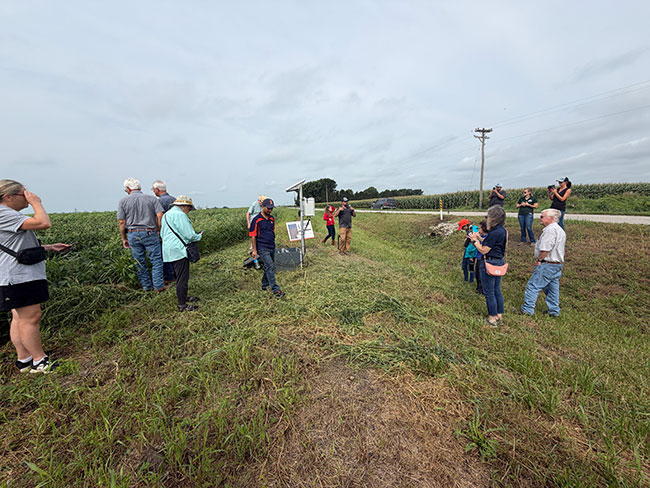
The group has also delivered multiple field days, through which they’ve seen hundreds of interested parties come out to learn more about the well-supported research data and see these partnerships in practice.
Best of all, Arch says, they’ ve had about eight bioreactor installations that came out of that. He credits the in-person, up-close experience of the field days for that. “You get to see some of that underground [work] that you wouldn’t normally see, post-construction..”
Other partners have come in along the way, like Minnesota engineering firm Ecosystems Exchange. The firm was originally doing private grant work, designing about 100 projects in their local watershed. Their grant was exclusive to design, with no money for construction. With Illinois LICA already providing that initiative, they were able to serve as – in Arch’s words – “the glue.”
“We’ve got designs ready to go, we have interested producers in this watershed, so we could pull in some practices and get some producers in.”
At its most recent field day, held this past August, the group showcased three conservation practices in a tour bus stop tyle. The audience included producers, agency folk and contractors. “We know there’s a lack of education – the research shows that we need more general education.”
Considering the day was pulled together in about three weeks, Arch thinks the 30 or so that showed up was heartening, although he says the group is always pushing for more, and adds that they’ve had “hundreds” come through before. “I think there were some serious folks in the room,” he says.
In the case of this field day, it showcased practices working together, which helped contextualize potential ROI, which Arch says is best understood in terms of yield daya. “Your biggest ROI is going to be with your drainage water management, whether you’re doing that manually or automated.” Drainage water management, also known as controlled drainage, can be incorporated ahead of these edge-of-field practices. He acknowledges that it’s harder to consider the ROI on saturated buffers or bioreactors, whose efficacy largely helps something that doesn’t make money – healthy waterways. However, in combination with drainage water management, which can help provide more water for crops in need during dry periods, it can be a real win-win.
And, Arch emphasizes, there are “decent programs” for cost-share across multiple agencies for these practices to be installed. “It’s not a bad time. There’s money out there.”
Water quality is the biggest resource concern in the Midwest, he says. “I hope all of us continue to work together to pool resources to continue to provide that education.” DC


