Contractor at Work
From farmer to contractor
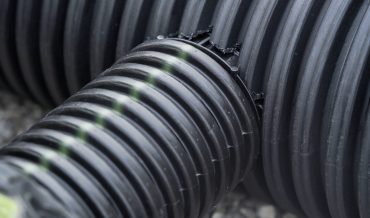
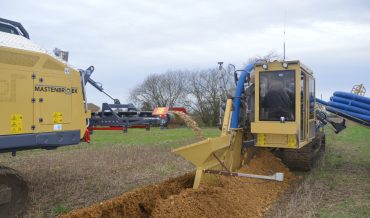
For many farmers, there’s no question what lowering the water table on land with drainage issues can do to improve crop yield. The challenge is finding a contractor with the experience and access to specialized tools to implement a successful subsurface drainage project to help improve the land’s productivity. For Frank Slemmons, this meant purchasing his own equipment to do it himself.Slemmons Excavating was established with a single Speicher 600 wheel trencher in the 1960s by Frank Slemmons, essentially as a complementary service to his farming operation, after recognizing that his own land required a drainage system. His son, Seth, purchased the wheel trencher and the business about 10 years ago, after he spent four years operating equipment for another construction contractor once he finished high school. Since then, Seth, his wife and company co-owner, Korie, and his brother, Aaron, have taken the business to a new level. The business started with only the brothers operating the equipment; they now have 10 employees. The business took a major leap forward in 2008 when they purchased a tile plow from a retired contractor, which helped them expand their geographical reach. The relationship they established with that contractor continues to this day and is something they consider a vital part of their business. They have also continuously upgraded the company’s fleet, adding several pieces of purpose-built equipment over the years.At present, their fleet consists of four John Deere backhoes, two Caterpillar tracked skid loaders, a Caterpillar D5 dozer, a newer Speicher wheel trencher, two newer Inter-Drain self-propelled drainage plows and an Inter-Drain 6050 chain trencher to install large, main, smooth flow drainage pipes up to 15 inches in diameter. The smaller drainage plows are used to install smaller, lateral pipes which tie into the main drainage lines. The perforated and corrugated plastic lateral pipes are buried about three feet into the ground in a carefully designed grid pattern and typically spaced about 40 feet apart. Between 900 and 1,100 feet of lateral pipes are typically installed per acre.Projects and Processes About 90 percent of the company’s work consists of subsurface drainage projects for agricultural clients that vary in size from produce farmers working on smaller land parcels to larger farms of up to 10,000 acres. Projects range in size from five to 500 acres. In addition to constructing subsurface drainage projects for agricultural customers, Slemmons Excavating and Drainage offers waterway and wetlands construction commercial site prep, pond construction, and general excavating.Over the past decade, the company has introduced advanced tools, such as GPS topographical mapping and customized drainage plans, to offer more precision to their customers.The first step is to meet with a customer, identify the parcel of land, and then find out what the farmer’s drainage objectives are for that parcel. Given their experience with subsurface drainage, the company can at this point offer technical advice on how the farmer can best achieve his objectives. Once that has been established, the company puts its tools to work.“We start all our projects with our own survey and design,” says Seth. “We use GPS to produce a complete topographical map of the farm. We take thousands of elevation readings across a field to generate a drainage plan to fit each farm separately . . . we do a 50-foot grid all across that land we are looking to drain.”Seth adds that having a well-engineered plan before burying any pipe is critical, and that the GPS topographical mapping and drainage plan have been excellent tools to help ensure that they don’t undersize their outlets and mains for the area to be drained.“We really try hard to use the technology to get it right the first time,” he says.The third step is to secure an outlet for the area being drained, and that may involve finding an existing outlet or creating a new one. If there is an existing ditch, it is necessary to ensure that it is a good outlet for the drainage system. They often must make adjustments to work with the existing infrastructure or lack of infrastructure to meet drainage plan objectives.“A lot of times we are limited by the existing outlets that are there, so it’s a challenge sometimes to work with neighboring landowners and get the ditches to the point where we have a good outlet, or to gain access to replace the existing mains,” says Seth. The final step is to put the design on paper, present it to the customer with an estimated cost, and wait for a decision.Once a project gets underway, two challenges must often be faced: the weather (which doesn’t always co-operate), and minimizing soil compaction on the jobsite.“We try to keep our traffic more or less where we are going to lay our new pipes so that we don’t create compaction on parts of the farm that aren’t going to be disturbed,” Seth says of the latter.Location, Location, Location While the company works for customers primarily within an 80-mile radius of West Liberty, Ohio (about 45 minutes northwest of Columbus), last year, they took their equipment on a road trip to Mississippi. This was largely because there is growing demand for subsurface drainage work in that area, Seth says, but it also extends their business season by a couple of months. Their busiest time of year is when the crops are off the field, which, in Ohio, is from September to May. Because crops come off sooner in southern states, Slemmons Excavating is taking advantage of this business opportunity.Seth says the drainage infrastructure is quite different farther south than it is in Ohio. “In Mississippi, there’s very little subsurface drainage, so there aren’t all of the old mains and ditches in place to do a good job to drain each farm,” he says. “So we are working towards getting those outlets established there.”
Rob Burtonshaw, a third-generation drainage contractor, has dedicated the past year to the study of land drainage. His passion for the business came naturally, but his pursuit to learn new techniques, find innovative technologies and talk to industry professionals is what makes him stand apart.Burtonshaw is committed to studying land drainage and its role in farming’s future. In 2012, he was named one of approximately 75 Nuffield scholars worldwide. He is the first Nuffield scholar to focus solely on land drainage, and the award provides his travel funds for one year to bring new ideas back to Britain’s farmers and drainage industry. Burtonshaw shared his learning experiences and preliminary outcomes with Drainage Contractor magazine in our November 2012 issue. His final research and conclusions will be presented to the Nuffield Annual Conference in November 2013. Until then, he continues to travel – talking to farmers, equipment manufacturers, researchers, and contractors – about what he knows best: land and field drainage.DC: What is the land drainage industry like in your area (United Kingdom)?RB: Agricultural land drainage in the U.K. has been shaped by the introduction and removal of government grants. After the Second World War, British policy focused on increasing agriculture production, and drainage was subject to grants, encouraging farmers to drain their land and increase yields. However, during the 1980s, the British government changed its policy and the grants were removed, but not before farmers invested heavily in land drainage, taking advantage of the grants while they were still available. Since then, very few hectares of land have been drained in the U.K.Farmers in our area experienced one of the wettest years on record this past year, exposing many old drainage problems – and the need to drain fields could not be clearer. It’s no surprise many farmers are keen to talk about drainage now. With the under-investment of drainage in the U.K. for the past 30 years, there is opportunity for industry expansion and I hope to use the Nuffield Farming Scholarship to improve our own drainage company, while promoting the importance and effectiveness of drainage.DC: How did you determine where to travel and whom to meet?RB: I started by asking people here in the U.K. for names and contacts of people they knew abroad. From these initial contacts I sent out inquires, asking to visit, and for recommendations of others I should meet. And then things just snowballed, and I had difficulty narrowing down the people to visit and fitting them into my travel schedule.I was eager to travel to Canada and the U.S., where drainage research is more common. I tried to meet as many people as possible – including more than 60 contractors, eight machinery manufacturers, seven universities, six pipe manufacturers, countless farmers and representatives of local governments. I have stacked up a lot of miles throughout my travels. And while some machinery salesmen may have travelled farther, my travels have been unique because I’ve talked to people in every aspect of the industry – from farmers to researchers, and fellow scholars to contractors like myself. I’ve traveled to Canada, the United States and the Netherlands. I also took the time to visit with industry representatives in the U.K., because the last thing I wanted was to travel halfway across the world only to be told about someone from home. DC: What have you learned so far?RB: The most important lesson so far is that enthusiasm is vital to any business. It can be difficult when a breakdown occurs or something goes wrong, but being positive and trying to drive the job and your company forward is what’s most important. Each place I visited had its own strengths and weaknesses. For example, nearly all the drainage crews in Ontario seem to be slick and work very efficiently, the trencher was never still for very long. I also noticed many American contractors seemed willing to embrace technology and use it whenever possible.I have a long list of ideas I’d like to apply to our own drainage company at home. It ranges from small things like using a pipe cutting “spade” used by most contractors in North America to alterations to our own machinery. GPS grade control is another idea I hope to take back home.DC: Were you surprised by any of your observations or outcomes?RB: I found that only by speaking to farmers, the end users of drainage, was it possible to gain a complete understanding of the entire drainage market in the areas I visited. Similarly, one of the advantages to meeting pipe and machinery manufacturers was to learn about their perspective of the whole industry. As contractors, we often work with our heads down and forget about the bigger industry picture.It was encouraging to meet fellow contractors who were very welcoming and open. This allowed me to gain an understanding of how they ran their companies and provided me a unique opportunity to learn from them, watching how others do the same job I do. I’ve often joked that my mission has been to take everyone’s best idea and copy them.DC: Did you learn anything about yourself along the way?RB: I feel very comfortable about my topic and area of research, and while most of my previous knowledge came from my father and grandfather, I now feel like I have a more rounded education and that I have seen more than most. And I’m more comfortable speaking in public now, already having spoken at a number of events about my research and the importance of drainage.DC: What have you learned from fellow international Nuffield scholars?RB: It’s almost impossible not to learn something when meeting a Nuffield scholar. Nuffield carefully chooses people with opinions and a willingness to express them. To be a Nuffield scholar you have to be involved with food production, so the expertise ranges across the farming industry. I have likely learned more about farming by talking to fellow scholars than from visiting thousands of farms each year, because when a drainage contractor visits a farm, the conversation focuses mainly on drainage rather than farming. A number of scholars in recent years have focused on soils, exploring subjects such as how to increase organic matter through cover crops or how to reduce compaction. While neither of these directly relate to drainage, drainage is all about soils – and the more information I can learn about soils the better.DC: What do you predict to be the next big step in technology for land drainage?RB: I suspect most contractors would agree GPS grade control will be the future, and for many this technology is already the present. There will come a time when laser graded machines will no longer exist, though I’m not sure if that will be five, 10 or 20 years away.Satellite images are also likely to play a larger role in this industry because, like many others, I already use Google Earth regularly. The resolution of these images is improving and there may come a time in the near future when we will be able use them to conduct level surveys.DC: What are your conclusions on the role of land drainage as it relates to the future of agriculture?RB: While my studies aren’t complete yet, I’m convinced drainage is underappreciated and that we, as an industry, need to be more active in promoting its benefits. Buried a meter below the ground, it’s easy for farmers to forget about, or overlook the work drains actually do.If predictions about world populations are correct, we are going to have to feed many more people, and we can only do this by becoming more efficient because we can’t produce more land. I’m also convinced that, despite vast improvements that can and probably will be made in the developing world, much of the grains will be produced in the most fertile and advanced areas. Drainage is a proven technology that can be installed almost immediately, and the resulting yield increases are significant. I can’t see how yields can be increased to the necessary level without drainage.Farmers will still be draining land in 50 or 100 years from now . . . as long as we grow crops, we’ll be draining land. Here in the U.K., many fields still rely on drains that were installed in the 19th century. These drains have provided great service, but nothing lasts forever and many systems are starting to fail. Land drainage will continue because, after all, drains don’t last forever.There is a moral duty to use the land as efficiently as possible, especially as pressure on the land increases. I can only see the amount of drained land increasing.To read our first interview with Burtonshaw, click here.
Industry News
May 13, 2013, New York – The Northern New York Agricultural Development Program (NNYADP) has announced 23 on-farm research, outreach, and technical assistance projects that are currently underway in several counties, including a focus on enhancing agricultural environmental stewardship with the use of tile drainage systems, reports the Madison County Courier. | READ MORE
We are living in an era of constant learning. New technology is popping up, research projects are being conducted, and there is an endless need to network and self-educate to stay on top of your game. It’s hard to find time to dedicate to education – especially as the spring and summer months approach. Rob Burtonshaw, a British drainage contractor, hit the nail on the head when he said, “As drainage contractors, we often work with our heads down and forget about the bigger industry picture.”What is the big picture? Burtonshaw is working his way through finding out the answer to this question. Burtonshaw was awarded a Nuffield scholarship in 2012 for his commitment to land drainage and its role in the future of farming, and we first chatted with him in our November 2012 issue. Burtonshaw is one of 75 people worldwide who received the Nuffield scholarship in 2012, and he is the first scholar to focus solely on land drainage. Something Burtonshaw has noticed so far in his travels is that learning opportunities are everywhere – especially hidden within conversation. In Burtonshaw’s eyes, the best way to gain understanding of the entire drainage market is by visiting farmers, the end users of drainage. So, when you’re following up with your customers, pick their brains about what they are noticing. Ask their opinion on matters relating to the drainage industry, whether it be about weather, soil conditions or crop improvement. In the meantime, read about Burtonshaw’s progress and lessons learned so far on page 18. Your peers also can be a great source of information, especially when it comes to the business side of your operation. Creating a solid business plan is so important to any company, and Dan Hodgman of Hodgman Drainage in Claremont, Minn., had the unfortunate reality of putting his plan into place when a tragic accident occurred. Hodgman’s story on page 10 is proof that a plan is critical. Whether you’re new to the industry or a seasoned veteran, our feature about how tile is made will pique your interest. When it comes to tile installation, you’re the expert. But it’s not often we see the work behind the end product. We’ve taken a behind-the-scenes look at the process of making pipe on page 8. It’s an interesting read about a pretty fascinating process. You may be a skilled contractor, but a little extra knowledge about the industry you’re so passionate about will only be an advantage. The timing of the content in this issue couldn’t be more perfect. As a newcomer to the drainage industry, I’m always looking for new things to learn, and I share the view of Burtonshaw: the best way to learn more about any industry is talking directly to those who are directly entrenched in it. I’m looking forward to meeting all of you to discover even more about the industry, the business, and you – our readers. If you have something to share, please let us know by e-mailing scroley@annexweb.com or connecting with us on Twitter @DrainageContMag. See you in the field.
Drainage Management Systems
May 16, 2013, Ireland – A farmer in Ireland has already seen the benefits of updating an outdated drainage system, writes the Irish Independent. | READ MORE
As a drainage or land improvement contractor, you know the general ins and outs of installing pipe. But did you ever wonder what it takes to make the giant coils of tile you receive? It’s not often you get a behind-the-scenes look at how pipe is made, from start to finish. Drainage Contractor took a tour of ADS Pipe’s Heidelberg, Ont., plant, to get a hands-on look at what it takes to turn raw materials into coils of drainage pipe.The three lines of the Heidelberg plant mainly run agricultural and commercial pipe. High-density polyethylene material is set at a let-down ratio to ensure the formula meets quality standards. “Based on specifications, we look to meet standard ASTMF405 for our four- to eight-inch single-wall pipe,” says Nathaniel Johnston, quality manager. “Ten-, 12- and 15-inch pipe meet the ASTMF2648 standard.” Each provincial or state association also has its own set of quality specifications, and pipe is made to meet the necessary regulations. Once the material is mixed to the desired standard, it enters the extruder where it flows through the machine and is melted down. From there, it enters a diehead, where it begins to be formed. The pipe continues to flow through into a corrugator, the piece of equipment that holds a clamshell mold to complete the pipe’s formation. “That machine comes in various sizes and molds, and the mold can be changed to fit whatever size is needed, depending on what the customer has ordered,” explains Brad Billings, plant manager. After it exits the corrugator, the pipe goes through a cooling process (water is used at ADS, but air cooling is also common at other manufacturers). Depending on the customer’s order, a perforation process is next. Water is wicked off and the pipe is perforated at the customer’s request. “If someone calls and says they want solid pipe, we would skip that piece of machinery,” explains Johnston. There are different perforators for different applications: fine slots for sandy applications, muck, for swampy areas, or regular perforation for standard applications. “Different markets require different perforations, and certain perforations are accepted more in different regions,” explains Jamie Turvey, Ontario agricultural sales representative at ADS. After the perforator, the pipe continues down the line through a puller to keep it moving, before it enters the packaging stage. If necessary, the pipe will go through a sock machine. “If a farmer found his land was sandy in a test hole, he’ll order a sock so the sand doesn’t get into the pipe,” explains Billings. In the packaging stage, if there are any flaws noticed in the pipe, the linesman will cut out the imperfection and fit it with a coupler. At this point, the pipe is packaged into large maxi-coils or smaller sizes at customer preference, and transferred to the yard to fulfill the customer’s order.The process itself is straightforward, but lots of time is spent on the line on quality control, ensuring pipe is manufactured to meet certain standards. “Even the raw materials are tested to make sure the specification sheet provided by the vendor matches up with the plant’s testing,” Johnston says. At ADS, samples are taken every hour and are recorded in a database and on a sample board. Measurements of each aspect of the pipe are taken, and pipe is subjected to several tests to ensure its durability, including a TUP or impact test to ensure the pipe doesn’t break or crack when it’s subjected to pressure, and a freezer test to ensure the pipe can stand freezing temperatures. Random samples are also sent to ADS’s quality lab in Ohio to ensure the information in the local plant’s database correlates with the lab’s test results. “Some of this pipe made today might not be used until July,” says Turvey. “There’s a database that tells us what we produced, when and where it was produced, for future reference if needed.” By the time the tile reaches the customer to fulfill its purpose, the drainage pipe has – quite literally – been put through the ringer to make sure it’s fit for the job.
May 6, 2013, Ohio – An Ohio State University scientist has created a two-stage ditch design, earning him the Ohio Agricultural Research and Development Center's 2013 Innovator of the Year Award, according to Ag Answers. | READ MORE
The agricultural drainage lines that drain water away from individual farmland tile systems are being replaced in a carefully orchestrated program that is expected to take 10 to 15 years. According to Tom Cummins, Montgomery County surveyor, “In a county like this, drainage is paramount because of the loamy and water-bearing soil. We have more than 200 regulated drains and somewhere between 360 to 400 miles of tile, and during the past five years this drainage infrastructure has just been falling apart.” Montgomery County, whose county seat, Crawfordsville, is 50 miles northeast of Indianapolis, has 505 square miles that is mostly farmland, mainly corn and soybeans.In Indiana and the Midwest, recognizing the need to drain the large numbers of watersheds dates to the late 1800s and early 1900s. Montgomery County landowners realized that it would be mutually beneficial to pool their money and construct common pipelines that would carry water away from their land. Now there are a combination of open ditches and subsurface drains that landowners pay taxes to maintain. It is not uncommon to have a large-diameter 18-, 24- or 30-inch clay or concrete tile or an open ditch that would be as long as three or four miles. Cummins has found that those clay and concrete tiles have outlived their useful life, have started to break down and collapse and today are being replaced with pipe made from high-density polyethylene (HDPE). “We started recognizing the problems that needed to be addressed,” he continued. “I spoke with all the contractors who are on my list for doing the repair work and got their feel for what was the best product out there. I had three or four who were actual tile installers, and got a lot of good information from them, what seems to be doing the best job and that led me to the HDPE pipe.”Mostly used in this county project is perforated, corrugated, smooth inner wall HDPE pipe made with virgin resin supplied by local manufacturer Fratco, Inc. (Francesville, Indiana). Pipe diameters range from 10 to 30 inches. The bidding contractor who was awarded the project selects the brand of pipe as long as it conforms to the specifications and any additional criteria set out by the surveyor’s office. “We have never had a problem with the Fratco HDPE pipe,” stated Cummins. “It meets AASHTO and ASTM specifications.”“Corrugated HDPE pipe is rugged because the material itself is rugged,” stated Tony Radoszewski, executive director of the Plastics Pipe Institute, Inc. (PPI), (Irving, Texas). “HDPE is abrasion resistant and will not corrode. Used since the mid-1960s for agricultural applications, the pipe is a flexible conduit for water that has continued to evolve to provide for the demands of an efficient farming operation and the environment of soil and water conditions. Today we have pipe that is delivered to the field on mega-size coils of thousands of feet, and on some reels there’s nearly a mile of three-inch-diameter pipe. This enables a contractor to tile acres of land rapidly. The very design of the HDPE pipe that permits perforations, which allow water to enter the system and be drained away, is the key.” PPI is the major trade association representing all segments of the plastic pipe industry.Today, installing a system is vastly easier due to advances in machinery and the pipe. “I’m a fourth-generation drainage contractor,” said Bart Maxwell, Maxwell Farm Drainage (Crawfordsville, Indiana). “We started in 1910, and we’ve seen a lot of things happen over the years. We started with clay tiles and cement, and some of the first plastic tile was put in by my dad, Bart Maxwell, Sr.”According to PPI’s Radoszewski, “The concrete folks like to say that their 100-year product life cycle is proven, because some of it has been in the ground for 100 years. But now it’s not automatic to replace it with reinforced concrete pipe (RCP), which is heavy, difficult to work with, and some contractors report there could be as much as a 30 percent cost advantage of HDPE pipe in labor and materials verses RCP. Installation of HDPE pipe can be done with an excavator, chain digging machines or a trencher.”“We experience so many different soil types and conditions,” Maxwell commented. “We usually try to look at it from the standpoint of ‘if there wasn’t any tile, how would we tile this field?’ You can’t of course do it without factoring in the course of the old concrete or clay tile.“One factor is the grade we use installing the pipe . . . . It could be a tenth of a foot per 100 feet of fall, or five-tenths of a foot per 100 feet. The grade is based on each job,” Maxwell said. “We are very cognizant of the need to increase the size of the pipe based on the lack of grade. Using GPS, we survey the field and plot the topography, lay the main in the lowest parts of the field and keep at least two feet of cover over the pipe just because of the depth of some of the farming tools. Three feet would be great on a 24-inch tile. Sometimes we’re 12 feet deep to catch really low areas such as at the end of the tile run. When you’re doing gravity drainage, and you’re not able to pump, you have to have constant flow through that pipe.”Maxwell generally uses a trencher machine wherever possible instead of an excavator. “A key factor is that we can cut the trench with a contoured bottom so the soil is not disturbed on the sides and putting some gravel backfill is the extra insurance and then the native soil. There are some places you can’t use the trenching machine and have to use a bucket excavator and this means more stone has to be used. Our trencher also grinds the soil finer than just excavating out. So when you push it back in you don’t have large chunks. We backfill with number 8 gravel or stone to bed the pipe.” To allow the trencher to more easily follow the natural contour of the land, Maxwell fitted it with a shorter boot. To facilitate a safe installation with this shorter boot behind the trenching machine, he used shorter lengths of pipe – 13 or 14 feet, and as short as 8-1/2 feet. Maxwell uses a 1971 Buckeye Super 7 Trencher. “Buckeye is building me a new one that will be delivered in October that will lay up to 36-inch-diameter pipe. The one we have now is slow by trenching standards, but as far as someone digging with an excavator or a backhoe goes, it’s very fast . . . about six feet a minute, that’s 36 inches wide, six to seven feet deep. In a day’s time, it’s no problem to do 2000 to 2500 feet, a half-mile of 24-inch or 30-inch-diameter drainage tile. We run Fratco XD Class II perforated pipe. On the farm field, we want perforated all the way around, which really drains the field.”“Once we install the new HDPE pipe,” continued Maxwell, “we go back and destroy the old tile, cut another trench on the opposite side of it to find any laterals coming in, so we can hook those in to the new system. It’s typical to lay about three trenches total to accomplish the job and we usually have a crew of seven to operate the trencher, feed the pipe and backfill.”Developing the planCummins and the five-member Montgomery County Drainage Board mapped out a program that included pinpointing the drains to be rehabilitated and a fair tax assessment plan. “It was a matter of going over what drains were taken care of during the past 20 years and seeing how much money came out of the assessments for these new ones,” he said. “We don’t assess people so that as soon as the money comes in we can spend it and then be broke until the following year when the assessments come in again. In the process of examining the books, it became evident that we were spending money as fast as it was coming in. The county collected taxes over the years and at this point in time they figured out that we spent more in repairs and maintenance on fixing broken clay or concrete tile, than it was really worth. We changed the method. Now we identify the drains that are needing constant maintenance and are getting to the point of doing a reconstruction, and fixing it from top to bottom. With a new drain we can keep the landowner’s assessment at a lower rate because it will be decades before any maintenance is needed on that drain. The determining factor is the number of acres in the watershed. Let’s say we have a 200-acre watershed; one farmer might own 20 acres, another 150, and so they figure the percentage of the watershed that they own and that’s the percentage that they will pay on that project.“It’s been during the past four to five years that we have started going gung-ho on the drain reconstructions,” Cummins explained. “We’ve put in close to 50,000 feet. That’s anywhere from 10- to 12-inch all the way up to 30-inch diameter-pipe. We have averaged four to five reconstructions a year with the smallest, generally, about 2000 feet. The longest one we’ve done to date was 6000 feet, completed during the summer of 2012 up in Crawfordsville, which is the main city in Montgomery County.” According to contractor Bart Maxwell, “A lot of people didn’t think anyone would spend money on these projects, they just wanted to patch up the bad areas. And then all of a sudden when progress was being made, people began showing up at the Drainage Board meetings, and were willing to spend the money to get new mains so they could expand their farm drainage system, and that turned this county around. Before, some people wouldn’t do a drainage system because they didn’t have a good outlet and they were never going to spend money on this tile even though it would help them grow more crops. Now at every meeting there are several landowners saying they have a problem and want the county to fix it because they see the success of the program and the way the tax assessment is handled.” For Maxwell, the past is truly prologue. “A customer of mine bought a farm the other day and he got a packet with information about the farm from the early 1800s,” he said. “There was also the original tile paperwork that showed it was my great-grandfather and his brother who had laid 18-inch tile across this farm. Tom Cummins plans showed that the tile is now coming up for reconstruction. It was installed in 1918 and now four generations later, I may very well be the guy who gets to redo my great-grandfather’s work.”
Business
Back in the late 1800s, investors averse to large risk held a major portion of their wealth in railroad bonds. Everyone agreed it was the safest place to keep your money to earn a modest but dependable return. But many people followed this practice without understanding the risks involved. The unforeseen emerging importance of the automobile resulted in the bankruptcy of so many railroads. Overdependence on conventional wisdom and following the crowd is only one of myriad risks facing investors. Nowadays, there are many more risks that are not necessarily market related. Many of today’s investment dangers are difficult to detect and manage. In the business of managing your wealth, investment behavior can be driven by career risk. At some levels of the investment business, there is a tension between protecting clients’ money and protecting your job. Driving this tension are the monthly sales quotas that many firms expect to be met by their sales force and the pressure not to be wrong on your own. We have all heard advisors say, “Well, everybody lost money last year.” To prevent being wrong all alone, many advisors watch what others are doing and flock for safety. The resulting herding action drives prices above or below fair value. Hidden fees – When purchasing mutual funds or segregated funds from an advisor, there are several ways he or she may be paid. You, the purchaser, ultimately fund all of these fees and commissions. If you don’t know what questions to ask or are not prepared to read lengthy documents, you may never be aware of the money that actually changes hands as the result of your transactions. In addition, the annual embedded fee charged by the fund company can run as high as three percent or more, before any returns get into your pocket.Regulatory bodies – You may never know if your advisor has been found guilty of breaking the rules as set down by the body that licenses him or her (for example, MFDA for mutual fund salespeople or IIROC for brokers). This is worth looking into. Results of an investigation will be posted on the regulatory body’s website; however, victims of wrongdoing and other clients are not normally notified. Before agreeing to work with any advisor, do your homework and visit the relevant website. Third-party verification of prices – Where do your statements originate? Are they produced on your advisor’s letterhead in his or her office? Is the information on the statement independently verified? As your first line of basic safety, insist that your money be held at an independent custodian from whom you can obtain clear reporting and disclosure on a timely basis. Fiduciary duty – A fiduciary duty is the highest standard of care in equity or law. A fiduciary must act at all times for the sole benefit and interest of the client. The fiduciary can make a profit, by consent, but he must not put his personal interests in front of his duty of care. It is appropriate for you as a client to ask your advisor if he or she has a legal fiduciary duty to you. If not, ask if you can have a fiduciary pledge signed. It is a contractual commitment that helps ensure that your advisor can’t profit at your expense. Darryl Cailes is executive vice-president at Enriched Investing Incorporated. He can be reached at dcailes@enrichedinvesting.comThis document is for information only and should not be construed as an offer, or a solicitation of an offer, to buy a security or investment service. Before making an investment, prospective investors should review offering documents that summarize the objectives, fees, expenses and associated risks.
I have lost count of the number of times I have said this, but I recently found a new reason to say, “Your closest competitor is not the next contractor down the road from your operation.”The first time I used this line of reasoning was sometime around 1978, at the Drainage Contractor Workshop in Indianapolis, to illustrate that the biggest competitive threat to contractors was the sales-savvy machinery dealer who would persuade the farmer to buy new iron rather than spend his money more wisely by investing in tile drainage.Now I say it for another reason. Maybe that contractor down the road is, in fact, your ticket to a healthy retirement. How is this?Let’s start with some perspective. There are fewer contractors around now than there were 10, 20 or 30 years ago. They are, in many regions, installing as much or more pipe with fewer machines than they did previously. They have more productive equipment, better technology and crews who have been coached and fine-tuned towards productivity as a daily goal. What’s more, they are likely providing their customers with better quality installations. Now, let’s now look at your customers. They are farming more acres than before, they have more sophisticated equipment than before and they know better than ever how to make money producing their crops. They have the wondrous GPS-based yield monitor that tells them what we’ve been saying all along: tile drainage pays. And, if they are worth their salt, they will soon be thinking, “Joe the contractor must be thinking about retirement soon. When he quits, who’s going to install tile on my farm?” If his contractor has not started his retirement plan, to pass along the business to his son or daughter, other family member, key man, or whoever, he will begin thinking, “I’ll have to look for another or buy my own piece of expensive iron.” Let’s not kid ourselves here: I’ve heard some farmers have already started doing this!For these reasons and more, contractors need to think about their own short- and long-term futures and the impact their decisions will have on the industry at large. If future demand for tile drainage work cannot be met by contractor capacity, other less-qualified operators will fill the void. Contractors need to have a plan and need to work their plan.I spoke recently on this topic to the Land Improvement Contractors of Ontario. Many of them have already passed the stage of handing on their businesses, but some have not. I suspect the situation is no different in the United States and other parts of the world. My message was: determine now that this has to be done. Then, get expert financial advice to make the transfer as seamless as possible and to reduce your tax exposure the best way you can. Meanwhile, make the financial burden on those who are taking over as low as possible. At the Ontario meeting, a local financial advisor, Ken Farrow, of Farrow Financial Service, based at Belmont, Ont., offered some tips in this regard. We presented several scenarios to represent typical contracting operations at the LICO conference. Farrow offered some advice to fit each of these scenarios, and advised seeking expert assistance from financial advisors and tax planning consultants. Case study no. 1Father and two sons (or sons-in-law): two drainage machines and crews, 3.5 million annual footage.Have already begun shared ownership transferHave been expanding the business base (more than tile drainage)Want to expand further, exploring optionsCase study no. 2Father, no second-generation that wants to take over: one drainage machine and crew,1.5 million annual footage.Option: key man wants to take over Consideration: buy new equipment, share costs with key man wanting in Option: sell out to neighboring contractor who is looking for growthConsideration: operate until the machinery wears out, then close downConsideration: buy new equipment, share these costs with nearby contractor as part of business transferCan you “get along” with the other guy during the phase-out?Case study no. 3Two brothers own the business, one wants to retire (or exit). One son wants to get in: one drainage machine and crew, 2.5 million annual footage. Father wants to treat both his sons equally, perhaps also a daughter who does not want to enter the business.Each contractor has a territory within which his business is generated. Going back to that Indianapolis workshop, we presented how to do this. On a regional map, draw a circle around your home base to encompass your customers. This is your trading area. Now draw a circle around the trading area of your nearest neighboring contractor and the next one, and so on. Some of these will overlap, (perhaps more than you’d like!). If you close down your business, which one of these will take over your territory? Perhaps your best retirement bet would be to approach one of them, who might have children already coming into the business, so that you can phase out while letting them phase into your area. They might buy out your equipment and pay you an honorarium as you ease out. They might need some of your financial stability to help finance this, but you may stand to gain from this too. The trick here is to think outside the box when looking for a solution. If you harbor ill feelings toward the one fellow who is the most likely to make a success of this because he’s been a tough competitor for so long, maybe it’s time to start the healing process. Most successful strategies are those that have been well planned and executed over a reasonable time frame. Succession plans are no different. At the end of the day, ask yourself what it is you want to leave behind. Do you want to retire with financial security? Do you want your customers to think you have done your best to ensure they continue to get the type of service you built your livelihood on? If the answers to these questions are yes, then begin planning now, if you have not already. Envision the situation that fits your operation. Then, begin a plan with your own financial advisor. Once you have your plan started, you can explain to your customers that you have secured the future of your service to them and now you can reap the rewards throughout your retirement.
New Products
Collect topographic data year-roundThe WM-Topo system is the latest addition to Trimble’s water management product lineup. The WM-Topo survey system is a portable topographic data collection solution for water management for year-round use in a variety of environments. The survey system includes a Trimble Nomad handheld computer and a pole-mounted GNSS receiver. The company says the system can be carried into areas not easily accessed by a tractor or truck-mounted equipment such as ditches and steep terrain, muddy fields, and fields with mature crop cover. The system can be used as an alternative, or to supplement, survey work previously conducted on the FmX integrated display. The TrimbleWM-Topo system can also be used to calculate the grade between two given points in a field in order to determine the existing slope or check the grade accuracy of newly installed pipe.www.trimble.com/agriculture Wolfe 540 plows 240 feet per minute The new Wolfe 540 Super Plow features a 540 Cat engine with 160,000-pound final drives. It plows 240 feet per minute in low speed and roads at a speed of more than four miles per hour. The long tooth plows over 7 feet deep. The Super Plow comes with a standard 18-foot track length or an optional 20-foot track length. The cab is heated and air conditioned with air ride. Incorporated in the machine control is the Plus 1 System, providing all hydraulic and engine functions. Both the engine radiator and hydraulic cooler have automatic reversing fans to blow out trash.The 540 Super Parallel Link Plow can be equipped with a GPS system that controls depth and tooth attitude to hold very tight grade tolerances. The GPS attitude control allows contractors to plow through unstable soils and carry the tooth on grade.A & E Construction Supply co-manufactures with Wolfe Heavy Equipment the Wolfe Man wheel trenchers and distributes Eager Beaver trailers to assist customers with their machine hauling needs. www.a-econstsupply.com Increase yields with Water GateThe Water Gate is a float-activated head pressure valve. It maintains a one-foot increase in water elevation between the downstream and upstream sides of the valve.The Water Gate operates in either free-flow or managed-flow mode. The managed-flow mode is activated by backing water up into the valve. This is accomplished by installing a Water Level Control Structure (WLCS) in the tile main at the lowest point of the drainage system that you wish to manipulate or control. Locate the first Water Gate one foot in elevation upstream from the WLCS. Water Gates can be used in series, locating additional units at one-foot elevation intervals. www.agridrain.comHaviland expands product lineHaviland Drainage Products has recently introduced a number of new products to complement its existing product line. Several different styles of end plugs in three-inch, four-inch and six-inch sizes and internal couplers from two inches up to 12 inches are available. Additionally, Haviland now manufactures rigid-style end caps in 12- and 15-inch sizes, a 12-by-10-inch reducer and 12-inch and 15-inch plastic drain grates. Dual wall pipe in a mini stick option (approximately 10 inches) is available for safety purposes. In addition to these products, Haviland also manufactures single wall pipe, dual wall pipe and CMP in a variety of sizes. www.haviland-drainage.com New functions added to Homburg Drain Cleaners Homburg Holland says its Homburg Drain Cleaners feature a water pressure as low as 10 to 12 bar. The HPE hose is pushed into the drain so that the specially designed spray head can do its work, cleaning the drain and removing fouling. The company has also introduced the automated Dynamic Drive unit. The term Dynamic Drive encompasses a series of new functions that have been added to Homburg Holland’s automatic drain cleaners, including obstacle protection, proportional control, traction and distance control and auto stop.www.homburg-holland.com Improve grade accuracy with EG2 from LatecThe EG2 EconoGrade Laser Grade Control System from Latec features 360-degree receiver technology. The EG2 is designed to improve grade accuracy and interfaces with any valve driven utility, including proportional time, proportional current and proportional flow valves with integrated electronics and can also control electric actuators. www.latec.on.ca AGPS adds new software featuresAdvanced Geo Positioning Solutions, Inc. (AGPS) has added a new feature to its Pipe Pro water management software: automatic steering (Autosteer) for self-contained tile plows. Notable features include dual-GPS input for accurate machine heading and accuracy up to +/- 0.1 feet. Autosteer allows steering to any LAY/PTL path selected in the program, including grid lines, designed drawings and offset paths. AGPS has also added Pipe Design, for use in conjunction with its drainage software solutions. With Pipe Design, users can draw mains with designed depth (including profile view), draw a group of laterals within a watershed boundary or other break lines, and export to AGPS Pipe software for automatic blade control in the field. www.agpsinc.com
Contractors must plan well ahead if they want to take delivery of a new or recent-model, used drainage machine. For their part, manufacturers are cutting, welding and fitting to meet the demand. Such is the state of a booming industry! A whirlwind survey has yielded several pieces of news on the specialist drainage machinery front.Wolfe changes ownership, moves to new shopThe next design changes of Wolfe Drainage machines will be introduced early next year, according to Ed Veeke, the principal of the company that purchased Wolfe Equipment in June this year. The business now trades as Wolfe Heavy Equipment. Customers can expect design changes. “Operator station upgrades will include improved creature comforts, increased size of cab, an air-ride cab and improved visibility of the work zone,” he says. Improvements are also being made in machine design to allow better access for maintenance, improved cooling, faster hydraulics, Tier 4 diesel compliance and improved overall esthetics. Veeke adds that, in the longer term, “We intend to have a full line of drainage and trenching equipment.”The company recently delivered its latest machine, the Wolfe 540 plow with a parallel link drainage plow assembly and increased ground speed when out of the ground. This machine was built in the new facility at Strathroy, Ontario, a 48,000-square-foot fabrication and assembly plant. Company personnel Keith Gillies and Dave Bechard continue with the business under the new ownership.Records spin at NorthlandIn Minnesota, Northland Trencher Sales’ Larry Neid reports: “2012 will be a record-setting year in sales for our company. New machine orders continue at a steady pace and the market is very good for late-model used trenching equipment. Plows are outselling trenchers by about three to one, and the largest model 2050GP plow is the favored size.” He adds that Northland offers buyers a choice of Cat or Volvo power in both plows and trenchers, with Cat being chosen more often. Lead time for new machines is currently one year from order to delivery.Recent changes and upgrades have been made on the Inter-Drain lineup as well as some fine tuning on existing models. The “SP” model plows that use single cantilever technology have been reconfigured to accommodate the Big “3” wide cab, which is the cab of choice. The company’s USA Package has been extended to include climate controls on the heating and air conditioning system. Larger high-speed track rollers have been added as well. “A popular new option in 2012 was the power grease system that will make the grease gun a fond memory,” adds Neid. On the trencher side, Inter-Drain now offers the larger 3035 model in the swivel steer 3035NT configuration, much like the popular smaller 2028NT. “This allows the track machine to turn a very short corner similar to a rubber tired trencher,” he says.BRON plans trencherWhile plow production is pumping hard to keep up with demand at RWF BRON, manufacturing has begun on a new wheel trencher at its plant in Woodstock, Ontario. This machine will dig a 36-inch-wide trench to 7 ½ feet deep. Powered by a 440-horsepower Cummins diesel, the first prototype was to have been completed late September 2012. Coming soon, says BRON’s sales manager, Mark Odorico, will be a new low-cost, self-propelled drainage plow, with expected delivery dates from the spring of 2013. The machine will feature D6 undercarriage and a 350-horsepower diesel. “Target weight is 68,000 pounds,” says Odorico.On the turfIt’s just over a year since sportsturf drainage specialists Shelton SDS launched the Supertrencher+ 760. Mick Claxton, general manager for the company, says the machine was built as a result of customer feedback. The initial concept came about almost three years ago, after the team had received a number of enquiries from customers asking for a trenching machine with improved performance in wet conditions as well as dry. Shelton’s design team developed a prototype machine and, after successful trials, a production version was engineered: the Supertrencher+ 625. This machine was successfully sold for 12 months and was capable of installing the majority of systems. However, drainage specifications in some countries called for deeper and wider trenches for sportsturf pipe work, so the team enlarged the design of this machine to create the Supertrencher+ 760, with digging capabilities to 760 millimetres deep and 155 millimetres wide (30 inches and 8.25 inches). The trencher incorporates many new features: a swinging main conveyor enables easy access to the exit port for cleaning and maintenance, and can be parked alongside the body of the trencher for transport. The transverse conveyor in the bottom of the exit port quickly moves the excavated soil onto the main conveyor to be elevated into trailers running alongside, preventing the soil from building up and blocking the exit port in wet conditions. An optional extra transverse conveyor can be fitted to the top of the exit port to help minimize blockages should the trencher be working in very sticky soils.The two-speed gearbox driving the digging wheel enables the operator to better match the digging speed of the wheel to the soil conditions: slow for wet soils and fast for hard, dry soils. The offset of this gearbox enables the machine to run down the center of the tractor. A removable section of the hood at the back of the machine enables the cutters to be changed from a standing position, which is a benefit to the operator for both ease and safety.Dual path control and parallelogram depth regulationThe Steenbergen Hollanddrain model EGS 3000 is available with a multifunctional joystick. This is a unique feature, which is highly appreciated by operators. The one-hand controllable joystick with numerous functions can steer both tracks and is called “dual path control.” Differences in track speed will be corrected automatically in forward and reverse modes. The mechanically driven digging mechanism and homemade “right angle gearbox,” chain transmission and safety clutches have all proven their durability. The “parallelogram depth regulation” system, available on the EGS 3000 model, results in the most accurate depth regulation possible. Hollanddrain believes that precision depth regulation methods and the way drainage pipe is placed are some of the most important requirements of landowners and contractors alike.